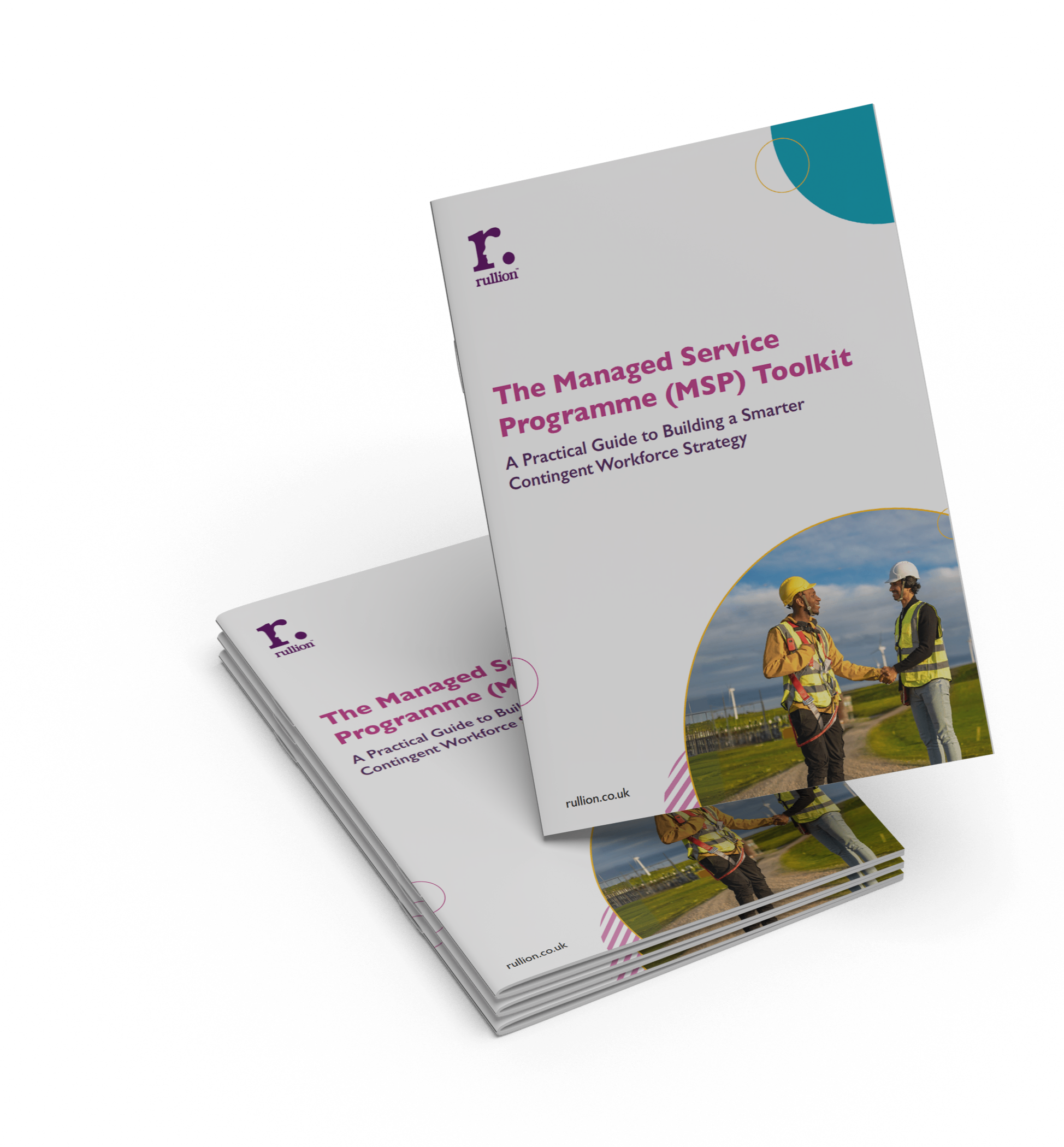
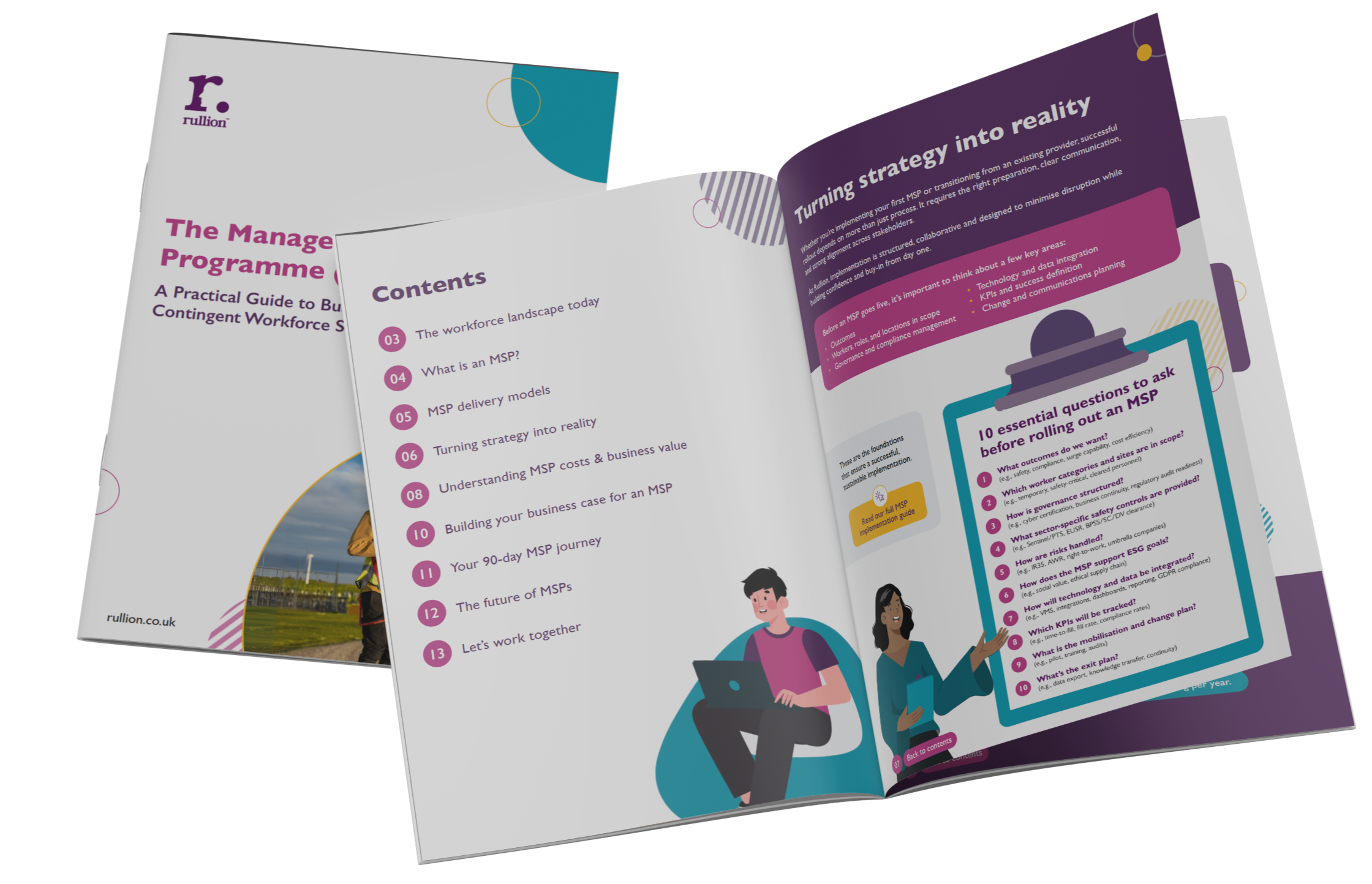
The Managed Service Programme (MSP) Toolkit

A practical MSP guide to building a smarter contingent workforce strategy.

<h1>The Managed Service Programme (MSP) <span style="color: #bd3383;">Toolkit</span></h1>

Why MSPs matter now

Major investment programmes such as RIIO-ED2 and AMP8 are accelerating demand for engineering, technical, and digital skills. Without a unified approach to contingent labour management, organisations face increasing cost pressure and delivery risk.

Managed Service Programmes provide the structure, governance and agility required to scale effectively while maintaining control and strengthening compliance in an increasingly complex workforce landscape.


This MSP guide gives you a clear, structured way to:

  • Assess your readiness for a Managed Service Programme
  • Identify the right MSP model for your organisation
  • Build a business case backed by data, value, and ESG impact
  • Plan, implement, and optimise your MSP approach


If you are exploring your first MSP or optimising an existing programme, this guide provides practical frameworks to help you take the next step in your journey.

Who is the MSP toolkit for?

The Rullion MSP guide has been created for leaders responsible for workforce strategy, cost, compliance and performance, including:

  • Procurement & Commercial leaders

  • HR & Workforce Strategy teams

  • Programme & Transformation leads

  • Engineering & Operations leadership

  • Hiring managers in complex, regulated environments

It’s particularly relevant for critical infrastructure organisations working across the:

Why critical infrastructure organisations choose Rullion as their MSP provider

Deep expertise in critical infrastructure

Engineering, utilities, transport, nuclear, energy, digital and technical talent.

Deep expertise in critical infrastructure
Market-leading fulfilment

90%+ direct fulfilment across core roles.

Market-leading fulfilment
Full compliance and governance

Total visibility of rates, suppliers, workers, and performance metrics.

Full compliance and governance
Tech-agnostic approach

Seamless integration with leading Vendor Management System (VMS) platforms to deliver real-time reporting.

Tech-agnostic approach
Supply chain and supplier performance management

A structured approach to supplier engagement, benchmarking, and continuous improvement, all driving stronger outcomes across your recruitment supply chain.

Supply chain and supplier performance management

MSP business case framework

Not sure whether a Managed Service Programme is the right next step for your organisation?

Use this quick framework to pressure-test the case for change, get internal alignment, and define what “good” looks like before you move forward.

Want more detail? These two short reads will help you go deeper:

Define the trigger

What’s changing (volume, compliance, delivery pressure, cost)?

Expose the blind spots

Do you have visibility of workforce spend, suppliers, and rates?

Agree outcomes

Speed to hire, governance, compliance, supplier performance, cost control.

Align stakeholders

The department includes Procurement, HR, hiring managers, finance, and programme leads.

Set success measures

KPIs you can prove in 90 days and optimise over 12 months.

Avoid the common MSP pitfalls

If you’re building internal buy-in, the full MSP toolkit gives you the complete business case framework, the key questions to answer, and what to measure in the first 90 days.

If you’d rather talk it through, our team can help you sense-check scope, stakeholders, and the right next step.

<h3>Avoid the common <span style="color: #bd3383;">MSP pitfalls</span></h3>

What's on your mind?

Our insights and tips on some of your most burning questions

6 Key Considerations When Changing Your MSP Provider

6 Key Considerations When Changing Your MSP Provider

Changing your MSP provider is a significant decision that can impact the management of your contingent workforce. Whether you're unhappy with the service, nearing the end of your contract, or simply exploring other options, there are several key factors to consider before making the switch. From understanding your contract and technology needs to planning for a smooth implementation, this guide covers the crucial aspects to ensure you choose the right MSP and make the transition as seamless as possible. For organisations that rely heavily on a contingent workforce, selecting the right MSP provider is critical. By carefully considering these six key factors, you can minimise disruption, reduce risk, and ensure that your new MSP can support your operational goals. Why Change Your MSP Provider? Assessing Your Contract and Exit Clauses Technology Considerations for Transition Impact of Changing Your Account Team Building a Strong Business Case for Change Successful Implementation and Communication Strategies Why Change Your MSP Provider? Before making a change, it’s important to first understand why you’re considering switching your Managed Service Provider (MSP). Are you dissatisfied with the level of service you’re receiving? Do you find that your current MSP doesn’t provide enough flexibility or efficiency in managing your contingent workforce? Key questions to ask include: Are you struggling with a lack of visibility or control over workforce spend? Is your current MSP unable to deliver in terms of compliance and risk management? Do you feel that your current provider lacks access to specialised talent, leaving you with recruitment challenges? Are your workforce strategies reactive, rather than proactive? For example, in industries like Energy and Utilities, workforce compliance and access to skilled labour are paramount. An MSP can help streamline compliance management while providing access to a broader pool of specialised workers. Similarly, in the Transport & Rail sector, workforce scalability and cost management can be a major challenge, making an MSP a valuable solution to optimise these areas. Having clarity on these points will not only help you articulate what you need but also ensure that the MSP you choose is better equipped to meet your goals. If you’re unsure, it might be worth speaking to a few MSP providers to understand how their services differ and which one can meet your unique needs. Assessing Your Contract and Exit Clauses Once you’ve established why you want to make the change, it’s time to turn your attention to your current MSP contract. Thoroughly review the terms of the agreement, specifically focusing on exit clauses. A strong contract will usually have an exit management section that outlines the steps for transitioning to a new provider. In particular, it’s crucial to understand: The notice period required for termination The responsibilities of the current provider during the transition Whether there are any penalties or fees for early termination The exit process can be complicated, especially if your MSP uses proprietary technology or has specific arrangements with suppliers. Make sure you’re clear on what happens with the current workforce, especially any contingent workers who may transition to a new MSP. Technology Considerations for Transition Technology is at the heart of efficient contingent workforce management. A well-integrated Vendor Management System (VMS) can help you track performance, manage workers, and ensure compliance with regulations. However, if your current MSP is using a proprietary or heavily customised system, you may not be able to keep it when switching to a new provider. Even with third-party technology, compatibility and transition agreements should be clearly understood before making the change. Key Technology Considerations: Proprietary VMS: If your current MSP uses a proprietary system, confirm whether this technology can be transferred to a new provider or if you’ll need to switch to a new platform. Customisation: Some MSPs spend significant resources customising their VMS for your business. Be sure to clarify whether your new provider can retain or adapt the custom features you rely on. Integration: Make sure that any new system integrates well with your existing HR, payroll, or finance systems to ensure smooth operations during the transition. Switching to an MSP with an updated, more advanced system can provide improved visibility, better compliance management, and more efficient recruitment processes. But it's essential to evaluate whether this will cause disruptions or require extra training for your team. Additionally, ensure the technology supports real-time data and robust reporting tools, especially in sectors like Tech or Energy, where data insights drive strategic decision-making. This added visibility will enhance operational efficiency and ensure better cost control. Impact of Changing Your Account Team One aspect often overlooked when switching MSP providers is the impact on your account team. It’s easy to assume that your existing account manager or team will transition with you, but this may not always be the case. Understanding TUPE (Transfer of Undertakings Protection of Employment): In some cases, the account team may be eligible for transfer under TUPE regulations. However, this doesn’t guarantee that the account team will remain with your new provider. They may opt to stay with your current MSP, move to another opportunity within their business, or leave the company entirely. It’s important to discuss this with both your outgoing and incoming MSPs so you have a clear understanding of who will be managing your account post-transition. An experienced team that knows your business can smooth the transition and provide continuity. Building a Strong Business Case for Change Switching MSP providers is a significant move, so it’s crucial to build a strong business case before taking the plunge. Engaging all key stakeholders in the process - from procurement and HR to finance and operations - is essential to ensuring that everyone is on board. When building your case, consider: Stakeholder feedback: Gather insights from teams who interact with the MSP regularly to understand what’s working well and what isn’t. Clear goals: Set clear objectives for what you want from a new MSP, such as better compliance, improved cost management, or access to a wider talent pool. Cost-benefit analysis: Weigh the costs of switching providers (such as transition expenses, implementation, and potential downtime) against the long-term benefits that a new MSP could provide. Involving all relevant teams early on ensures that everyone has a say and helps mitigate resistance to change down the line. A collaborative approach leads to a more effective transition and a smoother process overall. Successful Implementation and Communication Strategies Successful implementation requires careful planning and coordination across multiple stakeholders. The first step is to define clear roles and responsibilities, ensuring that everyone understands what is expected during the transition. Key factors to consider: Stakeholder involvement: Identify key individuals who will be responsible for managing the transition, such as project managers or team leads from HR, procurement, finance, and IT. Clear communication plan: A detailed communication strategy is vital to keeping all stakeholders informed about the progress of the transition. This includes informing your hiring managers, contingent workforce, and internal staff about the changes. Regular updates: Set up regular implementation meetings and establish a steering group to oversee the transition process, ensuring that issues are addressed promptly and that everyone is aligned on the timeline. Business Continuity At Rullion, we prioritise business continuity during transitions. Through careful planning and project management, we ensure that operations remain smooth with minimal disruption. Any potential risks are addressed proactively, ensuring that your business remains on track throughout the transition process. Effective communication helps to minimise disruptions and ensures that all parties are prepared for the change. Additionally, by communicating early and often, you’ll reduce the risk of uncertainty and dissatisfaction among your workers. Conclusion Changing your MSP provider doesn’t need to be a painful process if approached with careful planning and thoughtful consideration. By taking the time to assess your reasons for making the change, reviewing your contract, evaluating technology needs, and ensuring proper stakeholder engagement, you can ensure a smoother transition that benefits your organisation in the long run. If you're ready to explore how Rullion’s MSP services can support your business, visit our MSP solution page or book a discovery call with one of our consultants today.

By Rullion on 23 July 2025

NEWS
APSCo's MSP Award Shortlist for Rullion x E.ON Partnership

APSCo's MSP Award Shortlist for Rullion x E.ON Partnership

Rullion have been named in the MSP award shortlist "MSP of the Year" at APSCo OutSource Awards for Excellence 2025, celebrating excellence and innovation in recruitment outsourcing. This shortlisting recognises our standout Managed Service Programme (MSP) partnership with E.ON, one of the UK’s leading energy suppliers. “Making it to the MSP awards shortlist is a real testament to the partnership we’ve built with E.ON. It shows how a truly strategic MSP can make a difference, especially the fantastic work that Tracy, Terrie, and Sinéad did to adapt our MSP model to the needs of a fast-changing energy landscape.” - Lindsay Harrison, Chief Customer Officer at Rullion Over the past year, hiring demand across critical infrastructure has reached unprecedented levels. Our work with E.ON is a great example of how to manage a contingent workforce in the energy sector; we’ve delivered measurable results at speed and scale, without compromising on quality or care. An MSP Model Built for Impact Our success is based on a people-first, insight-driven delivery model that puts E.ON’s values and evolving needs at the centre. When it comes to managing a contingent workforce, no two clients are the same – and our E.ON solution is a high-touch, fully embedded partnership that delivers on compliance, cost control, agility and cultural fit. Rather than relying heavily on second-tier suppliers, we’ve implemented a direct fulfilment model that gives E.ON greater control over quality, consistency and cost. Through this, we’ve achieved 100% direct hires. a 2:1 CV-to-interview ratio, reduced time-to-hire by 15%, and improved interview-to-offer conversion by 25%. It’s a delivery model built for today’s critical infrastructure needs and ready to scale. A Hiring Strategy That Delivers Lasting Results Across Rullion, we use a behaviour-first hiring strategy. This means we don’t rely solely on experience. We assess candidates based on their potential and alignment with E.ON’s values and culture. This approach has supported smoother onboarding, reduced attrition, and improved conversion from contingent to permanent roles. In fact, 11% of workers placed via Rullion at E.ON converted to permanent roles, with over 85% retention across the MSP. Engagement has also increased, driven by ongoing development opportunities, wellbeing support, and a personalised, people-first experience. Outcomes That Speak Volumes Our bespoke Client Value Framework tracks five key pillars: cost savings, compliance, operational excellence, innovation, and social value. This is how we measure what matters. Here’s how that translates at E.ON: 99% fill rate across the MSP (92% at time of submission): critical roles are filled with consistency and speed, keeping operations moving without disruption. 100% satisfaction in post-hire surveys: every worker placed through our MSP reports feeling supported and set up for success from day one. 100% timesheet accuracy: contractors are paid accurately and on time – building trust, loyalty, and a positive experience throughout the assignment. +60 Net Promotor Score (NPS) from hiring managers: our delivery quality, responsiveness, and embedded team approach are consistently rated as ‘Excellent’ by our clients. 25% improvement in interview-to-offer ratio: we’re enabling faster decisions, stronger shortlists, and more efficient hiring cycles. Over 85% retention across placements: we place the right people, who stay – reducing rehire costs, protecting institutional knowledge, and supporting business continuity. 99% onboarding compliance: our rigorous onboarding standards ensure our clients remain protected and each new starter meets strict regulatory and process requirements. The 1% variance was due to delayed candidate documentation, not process gaps. These metrics don’t just sit in reports; we use this data to drive continuous improvement – from simplifying onboarding routes to improving IT access and escalation processes. These findings are then reviewed monthly at leadership level and implemented into quarterly business reviews to ensure accountability and momentum. While our MSP is led through direct fulfilment, we hold our niche supply partners we do work with to the same high standards. We measure their performance with quarterly scorecards and ensure they are aligned to our values. All of our suppliers are to adhere to our Supplier Code of Conduct, and we provide training on inclusive recruitment, host performance clinics, and share best practices to help partners meet standards and grow with us. A Managed Service Provider for the Future Our MSP at E.ON is a standout example of what we do best: high-performance hiring with a human touch, scalable solutions that evolve with business needs, and a shared commitment to inclusion and innovation. “Rullion is more than a recruitment partner – they are an extension of our team… They’re friendly, enthusiastic, and always translating insight into what really matters for E.ON.” - E.ON Stakeholder We’re proud to help critical infrastructure organisations like E.ON through strategic MSP and contingent workforce solutions.

By Rullion on 26 June 2025